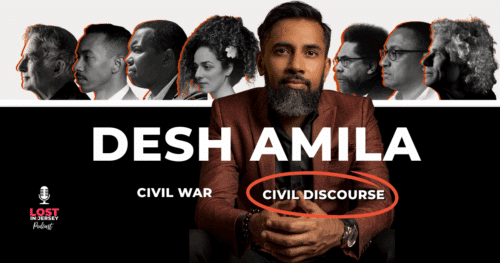


From Sri Lanka to Australia to New Jersey
How are world-class voices like Ta-Nehisi Coates, Richard Dawkins, and Cornel West coming to Montclair? The answer is Desh Amila, founder of Thinkable.
Born in Sri Lanka in 1981, Desh grew up during his country’s civil war, a time when propaganda and division drowned out real conversation. His father even spent years in hiding for his political views. Those experiences left him a lasting impression: change only happens when people talk honestly across their differences.
“When you give people a chance to listen deeply…even to those they disagree with…you create not just understanding, but community.” – Desh Amila
After moving to Australia, Desh built a career producing events that treated scientists and philosophers like cultural icons. What began as small tours grew into Thinkable. a global speaker series now finding a new home in Montclair.
Why Montclair
Montclair’s diversity, creativity, and curiosity made it the perfect place for Thinkable’s U.S. chapter. With events staged at the historic Lackawanna Station, audiences here will experience the intimacy of a town-hall dialogue with the energy of a live show.
Watch or Listen to the Conversation
In this Lost in Jersey Podcast episode, Desh joins Janette and Rachel to share his story and the vision behind Thinkable.
00:00 – Intro: Meet Desh Amila on Lost in Jersey
01:18 – Growing up in Sri Lanka’s civil war
03:41 – Moving to Australia and first steps in events
06:02 – Founding Think Inc. and making ideas cool
09:10 – Bringing Michio Kaku to Australia like a rock star
12:15 – Expanding to thinkers: Dawkins, Tyson, Goodall & more
16:22 – Why Montclair is home for Thinkable
19:44 – The lineup: Coates, West, Dawkins, Pinker, McWhorter, Alinejad
26:30 – The most controversial past event & lessons learned
32:55 – Building dialogue, community, and New Jersey roots
Janette (00:05)
Hello.
Rachel (00:05)
Bye.
Janette (00:07)
It’s nice to meet you. You look very podcast ready.
Desh Amila (00:10)
Thank you. thought you’d appreciate the
Janette (00:14)
We do.
first of all, how do you pronounce your name?
Desh Amila (00:17)
My name is pronounced Desh. Amila You can just call me Dash.
Janette (00:20)
Amila.
Desh Amila (00:21)
So my name is a massively shortened version of a name. If you ever meet a Sri Lankan, you’ll know our name starts here, our tag ins all around and back here again, because our names are very long. So this is a very short
Rachel (00:35)
Do they
Desh Amila (00:35)
you know.
Rachel (00:36)
is
it that you’re
acknowledging the mothers and fathers and different family members, like from your history, is that why they’re long?
Desh Amila (00:42)
That would make sense
if that was the case. It is not. It’s just things just have been add on over time. honestly, my parents don’t really know why certain parts of my name exist. So when I had a child, I just did not burden her with the six names I have that she doesn’t need other than her normal two names.
Janette (00:45)
Mm-hmm.
Rachel (01:01)
you
Janette (01:02)
So she
officially just has like a short name kind of like you do now.
Desh Amila (01:07)
Very short. We just made it very simple for her because
Rachel (01:08)
Yeah.
Desh Amila (01:10)
my name does not fit in a credit card. My name needs two lines on my passport. No joke.
Janette (01:18)
way that you came on our radar was all of a sudden there was a social media posting of Ta-Nehisi Coates coming to Lackawanna Plaza for a thinkable event. I went and looked at your website and then I saw you had a whole lineup of impressive people coming.
Rachel (01:29)
event.
Janette (01:36)
I was like, wow, we need to know what’s going on here. And so here you are to let us know a little bit more about yourself. Why is this all happening in New Jersey? And how did it all come about? So can you tell us a little bit about your connection to New Jersey first and then how this came about?
Desh Amila (01:51)
Well, I’ll start off there. I’m relatively new to New Jersey. It’s not even three years since I’ve moved here. I lived most of my life in Australia. Before that, I was born in a small little island called Sri Lanka. So since I moved here, I’ve been wanting to
attend ⁓ unscripted intellectual speaking events. Well, one part is because that’s what I’ve been doing in Australia for over a decade. there weren’t events like my first attempt is a bit of a selfish attempt. I want to go to these events. So that’s sort of the beginning of it. initially, we trialed a few things.
Janette (02:27)
Yeah.
Rachel (02:27)
Yes.
Desh Amila (02:32)
me and my team and there was a good response. It wasn’t in Montclair. It was still in. We did two things. One was
Brooklyn, New York. Then the other attempt was in Newark, NJPAC. And they had a decent response. live just around the corner from Montclair and I love Montclair. think Montclair is a fantastic place.
Rachel (02:40)
Mm-hmm.
⁓
Desh Amila (02:51)
So we thought, why don’t we just dive head first and put together something that the town doesn’t have. That’s where the speaker series came and we call the series Thinkable.
Janette (03:04)
Right. it was so impressive, the people that you have brought together from your other platforms. ⁓ can you tell us a little bit about your other work that you’ve done and how you started generating these great minds to come onto your platforms?
Desh Amila (03:19)
Well, it all started, I did my first event in Australia, Melbourne, Australia in 2005. ⁓ And that was on the back of a radio station. I was a radio DJ ⁓ for a number of years straight from university. And then I got sucked into the event industry and I was working with mainly hip hop and R &B very early stages in Australia touring industry.
After about four or five years of doing that, although I was enjoying it, I was losing a little bit of interest because I felt like some of the events were a little vacuous. People were there and it was great. was fun. because I was personally going through a journey, learning science, learning philosophy, ⁓ questioning what does it all mean. ⁓
Rachel (03:50)
Yes.
Hmm.
Desh Amila (04:10)
as people tend to go in their 20s of sorts. And I wanted to see, hey, are there events around this subject matter? And there were some of these speakers I was interested in, but they were in conference formats and they were at universities. And the last thing you want is, I I felt as at that point was to be lectured at again at university. I just finished my four year degree. I didn’t want to do any of that.
Rachel (04:30)
Heh.
Desh Amila (04:37)
And I was also interested in fashion and hip hop culture. there wasn’t anything cool for me to attend. So that’s when in 2010, I made a conscious choice to move from doing these entertainment events, which I still love, but I wanted to do something different. So I came up with a company called Think Inc. And the idea was to…
invite some of these public intellectuals, these very smart people, some of the smartest people in the world to events in Australia. And we would put on these events at sort of rock and roll slash hip hop venues and market it and try and get the cool kids to attend. And…
Rachel (05:21)
I love that.
Desh Amila (05:22)
Yeah, I mean, the first attempt was too ambitious. didn’t necessarily work. But the second attempt, as a true entrepreneur would do, you know, I didn’t give up on the idea. The second attempt in 2012, I gathered everything together again from not so big first attempt. And then I invited the co-founder of string theory, Professor Michio Kaku to Australia for a
Janette (05:26)
you
Desh Amila (05:47)
which ended up being a sold out tour. And that was the beginning. from there on out. So so Michio Kaku is NYU professor. So he’s from.
Janette (05:50)
Wait, where was he? Where was he?
Rachel (05:51)
Yeah, where did he come from?
Janette (05:58)
So he came
from New York. ⁓
Rachel (06:00)
Yeah,
how do you swing that? mean, as an event planner, you have to, do you pay for his ticket over? I mean that…
Desh Amila (06:07)
Yeah, we did everything.
basically I went up to him and I said, hey, you know, here’s the idea. We’re thinking of doing this tour in Australia. Here’s my background. We’ll do everything. we paid his standard fee, which was quite a bit of money because a lot of these speakers do commercial events, but they generally tend to be more at corporate events. So they’ll speak at
Rachel (06:25)
Yes.
Janette (06:29)
bright.
Desh Amila (06:29)
Google or Microsoft, but I said, hey, I’ll take the risk, I’ll pay your fee, come over and you’ll be speaking to a public audience.
I think the Sydney event, we had 2000 people. The Brisbane event had 1500 people. Melbourne had another 2000 people.
Rachel (06:44)
How did he feel? What did he say about his experience?
Janette (06:44)
So he was, yeah.
Desh Amila (06:47)
he was,
he loved it. He was, he was, he was thrilled. I remember a local newspaper writing, especially at the Sydney event. Sydney event was at the Sydney town hall, which is a smack bang in the middle of the city. ⁓ And there was this audience wrapped around waiting in a line to get in. And the media was
Rachel (06:49)
Yeah.
Desh Amila (07:07)
How
did this hard science event attract people lining up? Yeah, it felt like a concert,
Janette (07:10)
Like a rock star type of situation.
did you do that?
Desh Amila (07:15)
Well, I already had a database of people who would go to these hip hop and R &B events that we would organize. I started there. just told that database, our marketing, the poster did not look like a quote unquote a science event. It looked like a concert poster with scientists in the middle. our marketing was like
Janette (07:21)
Mm-hmm.
Desh Amila (07:37)
What would I want to see at these kind of events? And we’ve been promoting music events for a long time, so we knew how those marketing materials should look like. And also, the other key point is the price point. ⁓ big conferences where these speakers would normally go to, they’ll have a much higher price point. So we priced it at a price point that is similar to what a concert ticket would be.
Rachel (07:54)
Yes.
Desh Amila (08:01)
just any average, not like big name A-name celebrity concert, but just an average concert. that those two combined just appeal to the right people. Then the word spread, we also used a lot of social media and ⁓ then it worked.
Janette (08:15)
You’re marketing a scientist academic topic to concert goers,
A marketing company might say, actually, we need to market it to just a bunch of people that are showing that they are only interested in that. You opened it up to people that are interested in multiple things, not just one thing, music.
Desh Amila (08:32)
Well,
⁓ it was rather simple because I don’t have a science background and I was interested in what Michio Kaku was talking about, but I was interested in, at the beginning, somewhat superficially. For example,
I wanted to know if parallel universe were a thing. I wanted to know time travel. Is that something that can be achieved? you know, ⁓ to some degree, I was interested in quote unquote the stoner talk. you you talk about like, hey, man, is that like, so, but.
Janette (08:52)
Yeah.
Yeah, yeah.
Yeah, totally! I
Rachel (09:05)
Right.
Janette (09:05)
love it!
Rachel (09:06)
It’s the multiverse of Marvel. Is that like true? Yeah, yeah.
Desh Amila (09:07)
Exactly, exactly, exactly.
Janette (09:10)
Yeah
Desh Amila (09:10)
So, and Michio Kaku is the co-founder of String Theory. His work is all about parallel universes. He also has an element of futurism to it. So, I market it just like that. think our poster had a DeLorean in the
Janette (09:14)
Yeah.
Rachel (09:18)
Yeah.
Janette (09:23)
I love it.
Desh Amila (09:27)
I think we dressed him up. Yeah, I think actually come to think of it. Let me show you something.
Rachel (09:27)
That’s perfect. That’s perfect.
Janette (09:32)
It’s totally my mind. I’m like, I it is my mind.
Rachel (09:34)
Yeah, it is your mind. Let me see.
Desh Amila (09:35)
This is Michio Kaku
as a Jedi.
Rachel (09:39)
No way.
Janette (09:39)
my God, wait,
did you do that before or after?
Desh Amila (09:43)
This was actually
when we brought him back for a second time after the success of the first one, we made a limited of 120 units. And yeah, so we learned how to really out that.
Janette (09:46)
Yeah.
Rachel (09:54)
That is so
great.
that this is how to get science out there and more approachable. mean, it’s,
Desh Amila (10:00)
Yeah.
Janette (10:00)
So after you did that, right? Who was the next person up that you were like?
Desh Amila (10:04)
Yeah,
so after this worked out, I was on fire. I was like, okay, now we have to establish the brand. Let’s get as many people as possible. we didn’t want to just stick to just the hard sciences. So we were like, okay, who do you think will make sense? philosophers. come to think of it, From Michio Kaku, we invited another scientist who also speaks in the same space, Dr. Brian.
a Columbia professor. We invited Neil deGrasse Tyson. So that was like the science band. Then for the philosophy band, ⁓ we went for Sam Harris, Richard Dawkins, ⁓ Professor Peter Singer, who happens to be Australian but teaching at Princeton. we invited Jane Goodall,
Rachel (10:29)
Mm-hmm.
Desh Amila (10:45)
Lisa Randall, who’s also an American scientist, Ayaan Hissiyalli. That was more, Ayaan’s event was more in the sort of religion side of the, ⁓ lack of religion at that point. Steve Wozniak for business, And the list goes on. Anyone?
Janette (10:59)
Yeah.
Yeah, I have the list right here. It’s pretty
impressive. And you do go from science, philosophy, politics, activism, technology, culture, media, public intellectuals.
Desh Amila (11:11)
Yeah.
Rachel (11:12)
what is your underlying philosophy or personal mission statement for how to select a speaker? Or like, are you looking to show that you have, you’re open-minded that was a long way around asking about what’s your philosophy?
Desh Amila (11:25)
so
Janette (11:26)
Hahaha
Desh Amila (11:29)
look, I’ll answer that in two parts. When we pick speakers, we are very conscious of the potential platform we are providing to amplify a message. we try to get
Rachel (11:39)
Mm-hmm.
Desh Amila (11:42)
public intellectuals who have an intellectual grounding that is solid, whether we agree, whether I agree with that or not, at least they are intellectuals, are principal, and they’re not provocateurs just saying things to get attention. So if you look at anyone and everyone we’ve worked with, ⁓ it’s, yeah.
Rachel (11:59)
Yes.
Yes, I did notice that it I was
looking for the provocateurs actually I was like, uh-oh Well
Desh Amila (12:06)
⁓ We make it
Janette (12:06)
I mean, and there are kind of some that are in there, but
they don’t, but their hypothesis doesn’t fall apart immediately upon investigation of what they’re saying, right? But you could break it apart, but.
Desh Amila (12:15)
Sure, and that’s the thing. Sure, could,
Rachel (12:19)
Yeah.
Desh Amila (12:21)
I mean, this is where the, what I want to see is the intellectual disagreement. So there are speakers that you will fundamentally disagree with their position. However, they don’t come across or they don’t stand, they didn’t achieve what they achieved by…
Rachel (12:30)
Mm-hmm.
Desh Amila (12:36)
saying some incendiary thing just to get attention to them. There are lots and lots of them, especially now in social media. Lots of people say really, really horrible things and it’s just to get attention, not really. They’re not making an intellectual argument. So that’s key. Now, the second part is why this is important to me.
Rachel (12:49)
Mm-hmm.
Desh Amila (12:58)
from what I did in 2010 to what we are trying to do now. This is more of an evolution of it, especially this is more what is relevant, I believe, to America. And that comes from, I was born in 1981. I was born in Sri Lanka. 1981, Sri Lanka is known for war.
Nobody knows my birthday except for my parents, but if you know Sri Lankan history, 1981 is when the civil war broke out. So I’ve only lived through, I left Sri Lanka in 2000. I’ve only lived through Sri Lanka through a civil war. And I’ve seen things in my childhood and growing up there that no one should see, witness. My dad was in hiding for six years when I was very little because he was on a kill list, because he was… ⁓
Rachel (13:27)
⁓
Desh Amila (13:44)
pro-democracy and pro-capitalism, ⁓ that party was not… ⁓ Now, there were two things happening in Sri Lanka at that point. From the north, there was the civil war happening that was coming down. From the south, there was the Maoist rebels that was coming up. So the country was in utter chaos. It was literally on fire, suicide bombs going off all the time.
One thing I noticed is that it was very easy for people who had the megaphone. The only TV channels available were the government channels. Foreign media was ⁓ not available that much and they couldn’t go to certain places. Later, they were completely kicked out of the country and the country was entirely run on propaganda
That’s why a civil war like that lasted until 2009. now I can see in retrospect, nobody speak up or spoke about the other side that we were fighting, or no two people from either side had any meaningful conversation. This idea of not speaking to the other,
resulted in the war in the first place and then it sustained for another. Exactly. so for me, since I’ve been in the West and I’m very grateful for the opportunities I’ve received and I won’t be, I wouldn’t be able to do the things I’m doing if I was in the middle of that civil war and never left the country. So when I’m in the West, when I hear people saying things about the other side or the
Rachel (14:52)
Prolonged it.
Desh Amila (15:17)
the constant otherization that I see. Whenever they criticize the existing systems of the free society they live in, my ears perk up. like, I don’t think you truly understand what you’re saying, what you’re asking for.
Janette (15:31)
Mm-hmm.
Desh Amila (15:34)
I don’t know if you remember, in 2016, a lot of people were using the civil war metaphor very easily. 2020, every time America had elections, I think it’s after 2016, some words are just willy-nilly thrown out. And I find them to be scary, but for different reasons, because truly, no, I’m not
but I wanted to give speakers an opportunity to spend time.
discussing in detail the nuances of whatever that subject matter is. So I’ve been since I would say 2018-19 I’ve been specifically working on events and event series that are a little bit more challenging
This speaker series, again, if you see the list of speakers, you’ll see there are speakers that you might fundamentally disagree. I met with somebody who’s lived in this, and raised in this town who’s very influential and she told me, Desh, you’ve already got the town in two camps in having deep discussions about, do I want to go to this one and this one? I’m like, that’s the point.
Rachel (16:22)
Mm-hmm. Yeah.
Desh Amila (16:46)
That’s the point. It’s a serious, come and hear both sides of the intellectual argument, and then that’ll give you a perspective that you may have not heard before.
Rachel (16:47)
Yeah.
Yes, absolutely. I think that’s key for the times we’re living in right now. And for sure, when I looked at your list of speakers before I knew we were going to meet with you, I’m thinking, huh, I mean, from Dawkins, ⁓ you know, to Cornell West and Tenisi Coates, I thought it was interesting and I thought, what’s ulterior motive and goal? And
I thought it was very smart to make it a series or a subscription, because then it’s like, no, don’t just pick the people that you want to see because you agree with them. It’s come and see all of them, please. So you can then make your own decision, but you now have a basis because you’ve heard from their
Desh Amila (17:36)
I’m very grateful for you saying that. That’s exactly, I mean, this is from a
perspective. This is a model that I’m basically telling people, hey, you can’t buy one ticket because I know I can sell tickets to certain speakers and I know it’s harder to sell for the others, but I want everyone to hear all six.
Rachel (17:50)
Of course.
Desh Amila (17:56)
There’s a through line among all of these people. And if you just go and listen to the people you agree with, you’ve missed the entire point.
Rachel (18:02)
All right,
Janette (18:04)
I wonder what the final outtake is. Like where do you end up in the end? If you go to each one of these and we should go through them here in a minute is if you go through them and by the end you’re like I think they write a little bit here and I think that person was a little bit right here, a little bit wrong, a little bit right and everybody’s like you know a piece of a pie of what
Rachel (18:12)
Yes.
Janette (18:23)
What do we end up with in the end of all these conversations
Desh Amila (18:26)
people in New Jersey less focus on this tour and the people who will potentially attend this. This place is full of very smart, very curious, intelligent people.
Anybody who, let’s say you have a point of view that you disagree with.
but you haven’t heard it from the speaker, you’ve seen a clip of this speaker saying something you fundamentally disagree with. Now you go to the event, now you listen to this person, break down the said idea in detail, and then you may still disagree with it, but you now all of a sudden have a perspective. Where are they coming from? What is the intellectual grounding? They built that idea. Exactly. And then, right?
Rachel (18:45)
Yep.
How did they get to that those thoughts like that and you see them as human because you’re
Janette (19:07)
think that,
Rachel (19:07)
now are seeing yeah.
Janette (19:08)
yeah, I think that’s what the ultimate thing is to cool it down
Desh Amila (19:13)
exactly. And when you see it in that context, hopefully people will think things through before immediately reacting to something. And I think more than ever now, it’s so important. ⁓ People see things online and you get access to information almost immediately. And I see the reaction because algorithms and everything is optimized for that reaction. But hopefully this will get people thinking.
a split second saying, hold on, that doesn’t sound right. I saw this person, although I disagree with, but I don’t think this way portraying this person may be accurate. Let me look at the context of what they said. Then you will have a more level-headed approach. I think we need more of that than this short, very quick soundbite model of consuming information. Look, this is an uphill battle now.
more than anything with modern social media. So I am hoping the events that we’re putting here, this old school town hall style events, is what I’m calling it now. I want the community to get behind it. challenge the speaker. You will have the opportunity. There’s a Q &A session, audience Q &A session. Challenge them.
Rachel (20:22)
Yeah,
you’re going to be fascinated when you see the Montclair version of a Q &A because there are definitely going to be people that are prepared with statements and questions and it’ll be it’ll be fiery.
Desh Amila (20:31)
Great.
That’s okay, I think it’s important. think passion is important as long as it’s respectful. And I don’t think any of the speakers that’s there are going to be having a hard time answering a question. If it is about the specific thing that they’ve been working on their entire career, they’ll be able to, they’ll appreciate challenging questions.
Janette (20:36)
and so ⁓ yeah.
Rachel (20:41)
Yes.
Yes.
Is there ⁓ a mediator or are you interviewing each one of these candidates or like how is it how does how what’s the format going to look like?
Janette (20:57)
Absolutely.
Desh Amila (21:04)
So
this is an unscripted format. We haven’t picked all the moderators, but each event will have a moderator. So the 60 minute conversation with the intellectual, then there’s a 30 minute Q &A with the audience. And ⁓ there is a type of ticket that allows ⁓ some people to then meet the speaker if they are available for a meet and greet. Not all speakers are available. ⁓ Book signing, meet and greet, photo, ⁓ food and drink.
Rachel (21:17)
Okay.
Desh Amila (21:30)
That’ll happen afterwards.
Rachel (21:32)
Okay, that’s great. Yes.
Janette (21:32)
Let’s go through who the people you
have lined up. I know that they’re spaced out by a few months each one. So let’s go through
Desh Amila (21:40)
we’re starting off with Ta-Nehisi Coates I think he’s probably one of the most well-written public intellectuals. His writing is…
beautiful and the points he makes tend to have societal impact. mean he’s writing on the Atlantic about reparations really kickstarted the reparation conversation in this country and ⁓ obviously
Rachel (21:59)
Yes it did.
Desh Amila (22:03)
Lots of people agree with him, but there was also a very large cohort that disagreed with him. But again, this is an opportunity for him to maybe rebut some of the conversations, some of the criticisms that he’s received. Also his latest book, he talks about the Israel-Palestine situation. Again, this is an opportunity for people who disagree with him ⁓ about anything he’s written to challenge him. Then our second event is in February. ⁓
Rachel (22:28)
Mm-hmm.
Desh Amila (22:31)
And that is with Cornell West and John Wood Jr. Obviously, Dr. West is a self-proclaimed socialist, democratic socialist. ⁓ And John Wood Jr. is a small-c conservative. ⁓ We have to make a
point of difference now because conservatism in this country is this. So, and so he comes from a different school of thought. So they’re just going to have a conversation about America and modern America. ⁓ What values do Americans stand for?
Janette (22:49)
Yeah.
Rachel (22:49)
Yes,
you do, actually.
Janette (22:52)
Where?
Yeah.
Desh Amila (23:08)
what are the common denominators that bring a democratic socialist or a socialist versus a small c conservative together, because you’d be surprised that, you there are a lot of things they agree on, but there are things they fundamentally disagree on, obviously, with the economy and whatnot. So that’s happening in February. Then in March, we have the incredible Richard Dawkins, who will be celebrating.
Selfish Gene 50th Anniversary, his incredible book that changed our understanding of evolution science and biology in so many different ways. That book is 50 years old.
Rachel (23:45)
That is really, really
crazy to think about.
Desh Amila (23:48)
Right? So this is, think, the only event he’s doing in America to talk about specifically the selfish gene. That’s also a very misunderstood book by a lot of people. That’s going to be an interesting event. And then in April, we have Steven Pinker. Steven, obviously, I think he’s in more ways than one. He’s intellectual, he’s intellectual. He’s written some amazing books.
Janette (23:59)
Yeah.
Rachel (23:59)
Mm-hmm.
Mm-hmm.
Janette (24:06)
Mm-hmm.
Desh Amila (24:14)
He has a new book coming out later this year called When Everyone Knows That Everyone Knows. ⁓ He’s going to be talking about his book, but also his old books, Better Angels of Our Nature, Enlightenment Now. ⁓ So then I think we are taking a month break. ⁓ And then we are back in June.
Janette (24:36)
John McWhorter.
Desh Amila (24:37)
Yes, John McWhorter. So if you disagree with tenacity codes when it comes to reparation subject matter, chances are you would have agreed with John McWhorter. So this is why it’s important to hear if you’re in agreement with tenacity codes. This is a perfect opportunity to hear the other side. John McWhorter is also an academic and it’s a linguist. Earlier we were talking about names and they know why.
Rachel (24:38)
yeah.
Right.
Yeah.
Janette (25:04)
Yeah.
Desh Amila (25:04)
So he
has an interesting way of looking at subject matter through the lens of a linguist, but also a cultural critic.
His latest book is about ⁓ language. His book before that was very controversial ⁓ because it was talking about…
now almost a word that has completely lost its meaning, woke He wrote a book called Woke Religion I don’t want to speak on his behalf, but from a linguist perspective and also understanding how religion is formed.
Janette (25:28)
⁓ huh.
Desh Amila (25:37)
And his argument was that belief in a set of ideas, it’s formed a new form of a religion, ⁓ akin to a religion. But again, you can challenge him if you disagree with him, And then the final event, this one is super important because…
Rachel (25:44)
Mmm.
Desh Amila (25:52)
It is with Masih Alinajad. She’s a hero of mine. If you know her story, she will be your hero too, I guarantee that. She may not have the credentials and the books of the other speakers, but she has a life story unlike anything you’ve ever heard. She is, and I don’t say this lightly, she is public enemy number one for Iran. Iran has ⁓ tried to kidnap her once.
assassinate her twice in American soil. And just earlier this year,
second ⁓ group of assassins that tried to ⁓ assassinate her in a Brooklyn home were convicted. While that case was happening, FBI released that there was a third attempt at life and she was lucky because she didn’t end up going to the university to give this speech, but the
assassins arrived. So she has an incredible, if you ever seen Iranian women ⁓ with taking their hijab out and screaming women life freedom, that is all galvanized by Marcia Linejad. And she’s built an incredible social media platform to tell Iranian stories and Middle Eastern stories. Even within her community, she comes across controversial, but
I know for a fact she’s brave to a point where sometimes it feels a bit reckless, but she has this incredible belief that her life is devoted to freedom of her people. She’s women’s rights activist. And she doesn’t do many public events, obviously, for the fact that
Her life is constantly under threat. ⁓ She’s moved houses 21 times. I’m really looking forward. Immense security will be provided. This is the second time I’m doing a project with her. anyone who’s listening, thinking negatively, please know the FBI is all over this.
Rachel (27:30)
you be providing security to that point?
Janette (27:44)
know, I know a little bit about her because of my background being Iranian. And also I have some people in my orbit that are working with her on some projects that she’s got going on. She also, as you mentioned, within her own community has, you know, opposing, you know, people about, you know,
Desh Amila (28:00)
Of course. Yes?
Janette (28:03)
I think everyone really can find that coming to all of them, they’re going to be, their mind will be broadened, they will grow from it. also I think the ultimate goal of humanizing people’s perspectives.
is the ultimate goal it’s what we need, you know.
Rachel (28:19)
Yeah.
Desh Amila (28:19)
Thank
you. I want to add one more thing. When you go to these events, you’re going to see people around you.
you let’s say you’re going to an event, there’s a speaker that you fundamentally disagree with, you go to hear them and I promise you, you’ll be pleasantly surprised who is around you. Your peers, like your townsmen and women, and you’ll realize, wait, I thought a different kind of audience goes to these kind of events. And you’ll realize my perception of the…
potential audience for this speaker versus who’s around me are very different. And you get to speak to them as well after the event, before the event. And I think that is incredibly eye opening.
Rachel (28:55)
Mmm.
I like that when you were also saying like with the like a food or a wine and cheese or whatever that you would have people in the audience be able to interact with each other and see, we’re all here to broaden our minds. And yet we may have very different opinions on this topic and feel pretty passionate about it, but we’re still all here together. It’s like a nice.
Desh Amila (29:26)
Yeah. Yeah.
Janette (29:27)
Have you had in any of your past events a problem within the audience or there have been any large disagreements?
Desh Amila (29:34)
Well,
I think my most controversial event happened I think in 2019.
I had an event where the topic in conversation was feminism and that event ⁓ went a little off the rails, which was not something I was expecting. Yes, in the audience. ⁓
Rachel (29:56)
I would not have yet.
Janette (29:57)
in the audience, in the audience? And was it
men that were against? What was it? Tell us what the disagreement was.
Rachel (30:02)
In Sydney?
Desh Amila (30:03)
No, no, wasn’t Okay,
so ⁓ This event from the beginning I was a bit naive about the event So this event came about when I was at an event and I told somebody hey
came up in a conversation and we were talking about various subject matter feminism came up and to respond to somebody I said you know I’m a feminist and I went on to make my point and somebody said why do you call yourself a feminist and I said well from the literal definition I think pretty much most people here are feminists and said no and then we had a disagreement and I was like wait when did the definition of this word change I didn’t so I you know at that point I’ve read a few books and I got a few more books and
I read Kristina Hoffsummer’s ⁓ book about feminism and I read Roxane Gay’s book about feminism and I then I realized ⁓ this is different. They have two different point of views here so I thought that would be an interesting event and I invited those two ladies to come to Australia to do an event about feminism. ⁓ I realized something was off.
Janette (31:08)
Those two.
Desh Amila (31:17)
As we get closer to the event, we start looking for a host. And I’ve made lots of connections in Australia with the notable intellectuals, journalists, people with notoriety to host. So I have a massive list of people to pick from.
I realized something was wrong when every single one of them declined to host this event. I was like, what’s going on? have award-winning female journalists. Nobody wanted to host it. And then one of them was a friend of mine. She took me out to dinner and said, Dish, I don’t think you know what you’re getting yourself into. No one is going to host this event for this particular reason. And then she walked me through, she said, you’re gonna have to end up hosting it. And I said, I’ve been doing this for almost 10 years. I’ve never hosted this event. That’s not why I do this.
Janette (31:45)
Yeah.
You
Desh Amila (32:03)
I am the producer, I put this together, I don’t host. She said, look, you at least have a melanin force field, so you might be able to get away with this. You will not be able to find a host for this event. And a week out of the event, she was right, we couldn’t find a host. So I ended up hosting that event. And I got…
Janette (32:11)
Yeah.
Rachel (32:16)
Mm-hmm.
Wow.
Desh Amila (32:23)
a lot of help putting together how to host that event. That event is live on YouTube for any listeners who want to have an entertaining 90 minutes. ⁓ Anyway, when I host that event, I put what I thought were honest questions, trying to understand. But from my first question, things went south. Audience was divided into two and…
I’ve never had an event where they were debating live while we were having the conversation. People were yelling and saying things and we’ve never had that before. it ⁓ was a very challenging event. And then it got topped off.
After the first event, one of our speakers wanted no trace of the event on the internet. before we could even do the second event in Melbourne, Australia, I had a cease and desist letter. I had lawyers after me. It was a barrage of things. However, we were within our legal grounds. So it was a bit of a bullying tactic.
The event was trending in America, by the way, Twitter at this point, what was happening in Australia. And a bunch of journalists from here were paying attention. And then And then the New York article,
Janette (33:25)
Yeah.
Desh Amila (33:33)
the 5000 word in-depth investigative piece of what really happened and that got published and so yeah that was the one event that was crazy if anybody wants to know the inner workings of that read that
Rachel (33:43)
Wow!
Janette (33:44)
It just-
we’re going to link to it in our notes. That’s a cascading
Rachel (33:50)
Yeah!
how are you feeling you could turn the ship around while you’re on stage?
Desh Amila (33:57)
thing. It felt like a ⁓ sports game. I would hold a speaker ⁓ accountable to what they said, and then one group will cheer and go crazy that I did that. And then I would go to the other speaker and then the other group will cheer.
Rachel (34:09)
⁓
Desh Amila (34:15)
it was just a shouting matter. People were just crazy.
yeah. I mean, I wouldn’t have said that at an event, hashtag feminist. I would have been canceled immediately.
Rachel (34:18)
is so emotional for that topic.
Janette (34:25)
Yeah, yeah
Rachel (34:29)
my God, you’re
right. I just stepped right in that. But I’m emotional in general, whether or not I’m a woman or not. ⁓
Janette (34:33)
Ha!
Desh Amila (34:36)
No, by the way, I’m just
being… ⁓
Janette (34:38)
If she was a man, she’d still be emotional.
Rachel (34:41)
man I’d be fired up.
Desh Amila (34:43)
No, but I think
that I think we all are. I think there are certain stewards.
Rachel (34:47)
We all are, we just express
it, we express it differently because of
no, I was gonna say cultural expectations of how we behave. Oh my God.
Janette (34:52)
hormones. I’m sorry. We’re stepping in it a lot. They’re just like,
just like, you know, let’s just, you know, edit heavy editing on this episode. But I wanted to, I want to ask you that about that. You said that you have these on on YouTube. And so is there going, is that going to be also the same format? You’re going to have these on social media and YouTube or
Desh Amila (35:01)
Sorry. ⁓
Rachel (35:07)
no, i’m gonna let it run, janette
Desh Amila (35:14)
Mm-hmm.
Janette (35:19)
Is that different because you want to try to sell the tickets?
Desh Amila (35:19)
Well, let me put it this way.
yeah, let me put it this way. We haven’t made the decision whether we are going to put all the events on social media. Right now, our aim is to have this in-person experience. So we encourage people to come. Even if we release this on YouTube, I promise you it is not the same.
If you were in that audience of the feminist event, the energy there that happened, what happened and how everything went down, you cannot recreate it on YouTube. It’s not the same. my encouragement is please come because you will have a memorable six night experience.
Rachel (35:40)
No.
Right.
I also just wanted to ask how did you decide to do it at Lackawanna Plaza?
Desh Amila (36:05)
I was introduced to the owner of the venue and also the wonderful manager of that venue by my barber in Montclair. Shout out to Zane. ⁓
Rachel (36:14)
Okay. Yo, yeah, we
had him on the podcast
Janette (36:17)
We had Zane on
here, he’s great. Yeah.
Desh Amila (36:18)
Okay, yeah, so
Zayn told me about the place I went and had a look at it. One of things that’s very important to me is the community element of this. Again, you can live in a community with people you disagree with but you can still share a beer, have a cuppa and disagree. Zayn and I disagree on aliens. You can ask him because he talks about aliens and
Rachel (36:27)
Yeah.
Janette (36:36)
Mm-hmm.
Rachel (36:39)
Ha ha ha!
Desh Amila (36:41)
⁓ I’m like, okay, let’s look at this scientifically. Let’s look at our understanding of the universe. So we have disagreements all the time, but we… ⁓
Rachel (36:50)
So Desh, not pro alien. Zayn,
Janette (36:52)
Can
you tell him that you’ve had Neil
Rachel (36:53)
pro alien.
Janette (36:56)
on and that…
Rachel (36:55)
From the Eldergrass basement.
Desh Amila (36:55)
no, he knows. He knows. We’ve
had this conversation. I’ve told him, okay, next time when I work with Neil, I will ask him. There’s been some questions presented to Neil on behalf of Zane. Zane knows.
Janette (37:05)
Yeah, I’ve heard him.
Desh Amila (37:06)
the venue at Lackawanna is a historic location and I think it is meaningful if we can do this year in year out and the community comes over here and
build another community within the community that are unafraid to ask tough questions, listen to speakers, make new connections, and Lackawanna was the perfect place for that.
Janette (37:30)
I’ll give you a tidbit of what I tell people. We spoke ⁓ to the Montclair History Center, and she said that the Lackawanna Plaza was actually, ⁓ the architect died in the Titanic.
Desh Amila (37:45)
⁓ wow.
Janette (37:46)
Yeah, yeah, I was like, wow, that’s really interesting.
it’s even it is very historical building.
Desh Amila (37:50)
Yeah.
Janette (37:51)
I’m interested in all these type of topics like
that from I guess it is a stoner kind of thing, you know.
Desh Amila (37:58)
That’s not necessarily a bad thing, it’s your inquisitive mind, it’s ⁓ your intellectual curiosity. ⁓
Janette (38:00)
You
Rachel (38:00)
No.
Janette (38:04)
Yeah.
Rachel (38:05)
And looking
at, Jeanette, you’re great at this, looking at things from all different perspectives, not wanting to just swallow down one point of view, but be like,
Janette (38:11)
Yeah.
all of these people are definitely minds that are very relevant today and
forming people’s thoughts.
And I wish you so much success. And I’m excited. I’m excited that you’re doing
Rachel (38:24)
Yeah.
Desh Amila (38:24)
Thank you.
Rachel (38:27)
Yeah, in our backyard.
Desh Amila (38:27)
Thank you so much, I appreciate it.
Janette (38:31)
⁓ that’s right.
Rachel (38:28)
But we can’t let you go until you tell us something
you love about New Jersey,
Desh Amila (38:33)
This is actually quite easy. This was a bit of a surprise for me when I discovered I love nature. was born in the hill country and surrounded in greenery. So discovering some of the incredible parks, I know it says garden state. for some reason it didn’t register nobody exactly.
Janette (38:51)
I know nobody thinks that. Yeah.
Desh Amila (38:54)
New Jersey and garden is not something, there’s almost a disconnect, but I realize it’s quite literal. ⁓ It’s a beautiful place. ⁓ live just across the road here is a beautiful park. that’s for me, that’s the number one thing. I love the ⁓ gardens and parks.
Rachel (39:01)
Yes.
It is.
Janette (39:13)
Yeah, yeah, yeah. It’s a
So I agree. So, well, thank you. And maybe we’ll see you at the park sometime.
Desh Amila (39:15)
dead.
Rachel (39:16)
Thank you.
Desh Amila (39:20)
Well, I’ll definitely see you at the event.
Janette (39:23)
We’ll see you at the event for sure. Yeah.
Rachel (39:23)
yes, for sure. We’re really looking forward to them. So thank you.
Desh Amila (39:27)
Thank you
so much. Really appreciate having
Thinkable. Season Highlights
This season’s Thinkable lineup includes:
Ta-Nehisi Coates — acclaimed author and public intellectual. His work in The Atlantic on race and reparations shaped national conversations in America.
Cornel West & John Wood Jr. — a cross-political dialogue on America today. West is a renowned philosopher and activist; Wood is a civic leader and former Braver Angels national spokesperson.
Richard Dawkins — evolutionary biologist and author. Celebrating the 50th anniversary of The Selfish Gene, a landmark in science writing.
Steven Pinker — bestselling author and Harvard professor. Known for works like Enlightenment Now and The Better Angels of Our Nature on progress and human nature.
John McWhorter — linguist and cultural critic. Columbia University professor, writer for The New York Times, and author of Woke Racism.
Masih Alinejad — global women’s rights activist. An Iranian journalist and campaigner for freedom, she is known for her fearless advocacy against compulsory hijab laws.